Proxima b: know your planet
Proposal section 1: the planet
Stand anywhere in the inhabited belt of this world, and you will see the same thing the first settlers saw, the same thing their descendants will see in ten thousand years: the star, huge and red, resting on the horizon. It does not rise. It does not set. Noon and midnight are not times here; they are places. Walk a few hundred kilometers toward the light, and you reach lands where the star hangs higher, and the rivers run warm. Walk the other way, and the star sinks, the sky purples, and the ground gives way to ice that has never once seen dawn.
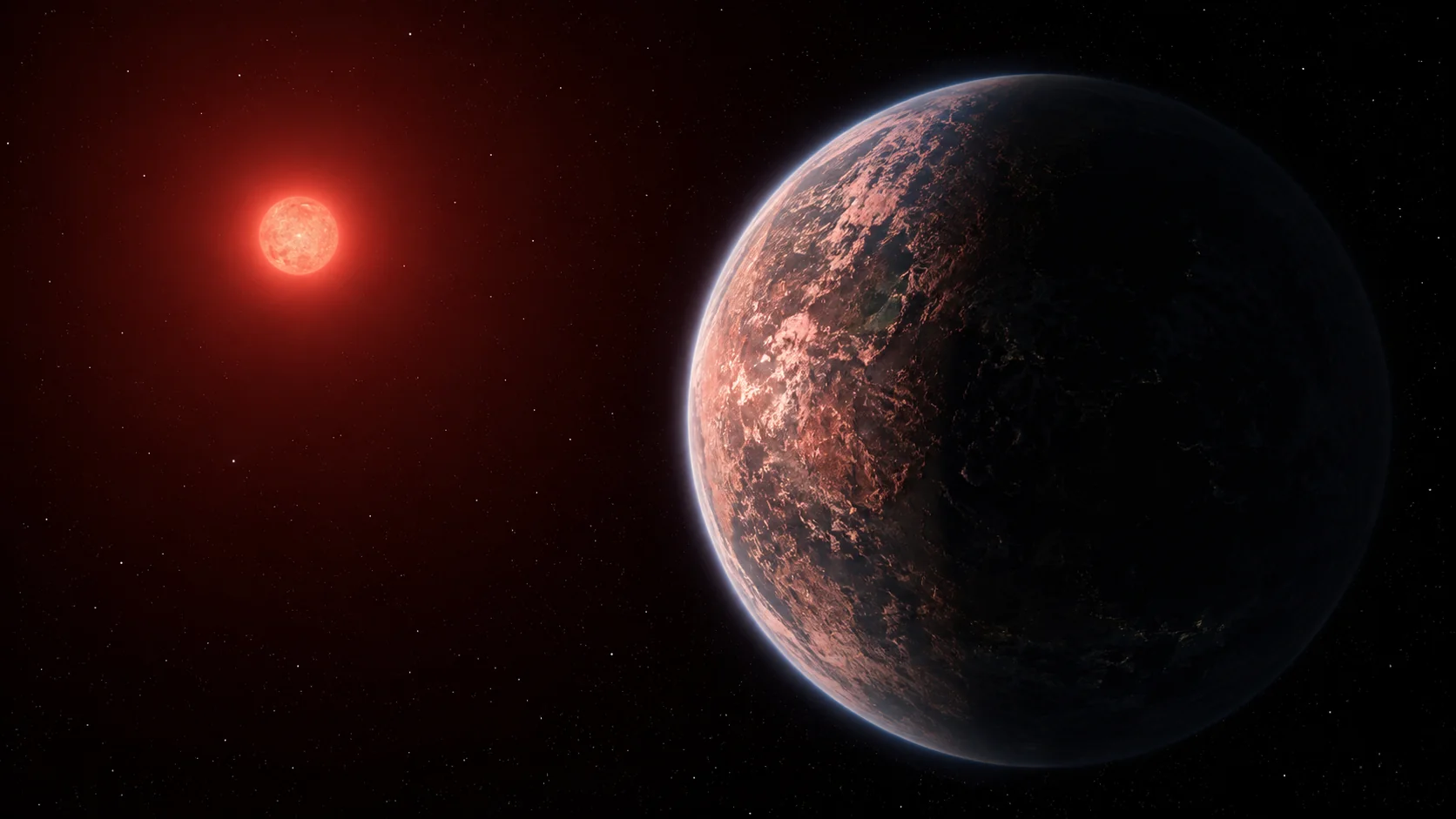
We are Terminus Systems. An artificial intelligence has asked for proposals to connect this world's young civilization to a large language model served from orbit. Before we can put a single satellite in the sky, we have to understand the sky we are putting it in — because this planet breaks almost every assumption a satellite engineer brings from Earth.
A world with one face
Planets spin, and they orbit their star. On Earth the two motions are wildly different: one spin takes a day, one orbit takes a year. But gravity, given enough time, likes to tidy this up. A star pulls harder on a planet's near side than its far side, and over billions of years that uneven pull acts as a brake on the spin. For a planet orbiting very close to its star, the braking usually ends in the simplest possible state: the spin and the orbit take the same time, and the planet forever shows one face to its star.
This is called tidal locking, and you have seen it yourself: Earth's Moon is tidally locked to Earth, which is why there is a "far side of the Moon" that no one standing on Earth has ever seen.
Our reference planet is locked to its star. Here is the model we will use for every calculation in this proposal:
| Property | Value |
|---|---|
| Radius | 6,371 km (Earth-sized) |
| Mass | 1 Earth mass |
| Rotation period = orbital period | 11.2 Earth days |
| Distance from star | about 7.3 million km (0.0485 AU) |
| Star | a small, cool red dwarf |
Notice how close the planet sits to its star. An astronomical unit (AU) is the average Earth–Sun distance, about 150 million km, so 0.0485 AU puts Proxima b at roughly a twentieth of Earth's distance from the Sun. Red dwarfs are dim, so the habitable zone hugs the star, and planets that close are exactly the ones gravity locks.
"Spins exactly as fast as it orbits" is a sentence the eye slides over, and it invites the most common misreading of tidal locking: that a locked planet does not rotate. It rotates constantly. That is easier to watch than to read.
Watch the two dials first. One fills as the planet completes a lap of its star; the other fills as it completes a turn on its own axis. Locked, they fill in step and finish together — one revolution is one rotation, to the second, forever. The planet carries a painted arrow so the turning is visible: the arrow keeps its aim at the star only because the body under it never stops turning.
Then try the other spin rules, because the lock only makes sense against them. No spin nails the arrow to the distant stars — and the star wheels around the sky anyway, once per lap, handing the town a sunrise every orbit. A planet that truly did not rotate would still have days. The lock works the other way around: the planet must keep turning, at exactly its orbital rate, for the star to stand still in its sky. You can rehearse this with a chair: walk a circle around it while keeping your face toward it, and by the time you return you have turned your whole body through one full rotation — one lap, one turn — even though the chair never left your sight. 3:2 spin is the third rule, three turns every two laps, and its sunrise counter ticks once every second lap. File that one away; a planet that settled for it instead of locking is waiting at the end of this section.
Life on the line between day and night
A locked planet has a permanent day side and a permanent night side, and neither is kind. The day side bakes under a star that never moves; the night side radiates its heat into space and never gets it back. But between them runs a ring where the star sits forever on the horizon — an endless sunset wrapped around the planet like a ribbon. There, temperatures can be gentle. Water can be liquid. Crops can grow in the low red light.
That ring has a name: the terminator — the line dividing day from night. Every planet has one. On Earth it races around the globe once a day at over a thousand kilometers per hour, which is why our sunsets last minutes. On a locked planet, the terminator is nailed to the landscape.
Why the twilight is temperate
Strip the air away, and this world would have no habitable band at all. It would have a griddle and a freezer meeting along a line, scalding on one side and cryogenic a step away, with nothing gentle in between. Everything livable about the terminator is the work of moving air.
The circulation that does it is the simplest a planet can have, and nothing like Earth's. Earth is heated along a belt — the tropics — and spun fast enough to shred the flow into bands: trade winds, jet streams, storms marching in rows. Here the heating is not a belt but a point, the place directly beneath the star, where the light falls straight down and never moves. Air over that point rises in a permanent column of convection and spreads out at altitude toward the dark. Over the night side nothing warms it; it radiates its heat to space, grows dense, and sinks. Then it comes home along the ground — a planet-wide surface wind flowing out of the night, across the twilight band, back toward the light. One loop, one direction, forever. Meteorology calls a closed circuit like that a convection cell; Earth runs three of them stacked in each hemisphere, and this planet has exactly one.
Except that "one direction" is the sentence a reader's eye slides over, the way it slid over "spins exactly as fast as it orbits." The loop runs in two directions at once, one above the other, and no map drawn looking down at this planet can show that. This one is a slice.
Follow one tracer all the way round. It climbs over the point beneath the star, crosses to the dark seven to ten kilometers up, sinks over the ice, and walks home along the ground — slowly on the return, because the surface leg is broad and the air down there is dense. Both legs are running at every instant. The one that matters to anyone standing in the band is the lower.
Then watch the vane on the terminal, which is the only instrument here that a settler would recognize. It wanders a few degrees and does nothing else. There is no sunset to turn it, no season to swing it, no night to still it — so the reversal counter reads zero, and it will still read zero when the terminal is retired. Now stall the loop, and the second mode runs the counterfactual that this whole planet is an argument against.
So the habitable band is not simply the place where the light arrives slanted. It is the place where the returning air has been warmed on its way in while the starlight overhead is still weak — a temperate ribbon held open by a heat engine that never switches off, because the thing driving it never sets. The 11.2-day rotation is slow enough that this day-to-night overturning dominates, but not so slow that spin is irrelevant: it deflects the flow into an equatorial jet that drags the hottest ground somewhat downwind of the point beneath the star.
Two consequences matter more than they sound.
The circulation is why there is an atmosphere at all. On a locked planet whose air moves too little, the night side becomes a cold trap: the atmosphere drifts there, freezes onto the ground, and never comes back. The planet strips itself of its own sky, and the twilight band goes with it. A thick, briskly mixed atmosphere is self-preserving; a thin, sluggish one is not. This world kept its air, and that fact sits upstream of every other fact in this proposal.
The band has weather. Over the substellar point stands a permanent tower of cloud, vast and bright, shading the very ground that raised it and throwing a good share of the starlight back to space — the day side's own thermostat, and part of why it merely bakes instead of sterilizing. Most of the water lifted there falls back there. What reaches the twilight band is the tail of that system: a prevailing dayward wind that never changes direction, cloud that comes and goes, rain rather than deluge, and, along the dark edge, meltwater from ice that has been piling up since the planet cooled. There are no seasons — no tilt worth the name, and no year to distinguish from a day. But the sky is sometimes clear and sometimes not, and when this proposal picks radio frequencies, that will cost us a second band.
The band we must serve
The civilization we are asked to serve lives in a band reaching about 20 degrees to either side of that line — roughly 2,000 kilometers of twilight country. Cities on this world do not have a north side and a south side so much as a dusk side and a dawn side; the star's fixed position is the compass every child learns first. All the ground terminals we must serve, now and for centuries, will sit inside that band.
For a network designer this sounds like a gift. The users never move — not just the people; the geography of demand is frozen. Design coverage for the twilight band, and you are done forever.
Hold that thought. It is about to fail, for a reason invisible from the ground.
Fixed to the ground is not fixed in space
Here is the subtlety that shapes this entire proposal. The terminator is fixed on the surface — but the surface itself is turning. The planet still rotates, once per 11.2-day orbit; that slow rotation is exactly what keeps one face pointed at the star. To anyone standing in the twilight band, nothing ever moves. But watch the planet from far away, from among the stars, and you see the terminator swing around in space, one full turn every 11.2 days — about 32 degrees per day.
Why should a civilization that never sees this rotation care? Because satellites do not orbit the towns; they orbit the planet, on paths that keep their orientation relative to the distant stars, not relative to the ground. A satellite path arranged perfectly over the twilight band today will find the band has slid out from under it, 32 degrees onward, a day later. The towns stand still, and the sky drifts. Every constellation design in the posts that follow is, one way or another, an answer to this fact.
How round is this world?
That last claim deserves a challenge, because on Earth it would be a lie. Orbits keep their orientation relative to the distant stars only around a perfectly round planet. Real planets bulge at the equator, and the extra mass in that bulge tugs sideways on every passing satellite, walking its orbital plane slowly around the poles. Around Earth the effect is brutal: a low orbit's plane can be dragged through several degrees a day. Satellite engineers have spent sixty years either fighting it or exploiting it.
So before we promise that our rings will stay where we put them, we have to ask how fat this planet is around the middle. Nobody can measure it — we know the planet only as a shadow crossing a star — so we reason from the one bulging planet we have measured to death.
A planet bulges because spinning flings its equator outward against its own gravity. The tug-of-war is captured by a single ratio: centrifugal push at the equator divided by gravitational pull. Feed Earth's numbers in, and that ratio comes out at about 1 part in 290 — and Earth's measured squashing, 1 part in 298, follows from it almost exactly. The recipe works. Now spin the planet down.
And here Proxima b's defining feature does the work. It is tidally locked, so it turns once every 11.2 days instead of once a day. The bulging effect depends on the square of the spin rate, so turning 11.2 times slower makes it 126 times weaker. This world should be a nearly perfect sphere.
Nearly — because being locked cuts the other way too. A world that keeps one face to its star is squeezed by that star forever, and it carries a permanent bulge pointing at the fire, quite apart from the one its spin raises. For a locked planet the two are governed by the same slow rotation, and the tidal bulge turns out to be the bigger of the pair: together they come to two and a half times what the spin alone would manage.
Do the arithmetic, and this planet's oblateness lands at about one part in fifteen thousand, against Earth's one part in three hundred. Fifty times rounder. If Proxima b were a meter across, its equator would bulge sixty-six microns — roughly the width of a human hair.
J2, and why a bulge becomes a series
The number has a name, and the name is worth understanding, because it is the one piece of geophysics this whole proposal leans on.
A perfect sphere has beautifully simple gravity. From anywhere outside it, it pulls exactly as though every gram sat at the center — one term, falling off as the square of the distance, and nothing else to say. Newton proved it, and every orbit you have ever imagined assumed it.
No real planet is a sphere, so no real planet has that gravity. But you cannot write down a separate rule for every lump. What geophysicists do instead is the same trick a sound engineer uses on a waveform: build the complicated thing out of a series of simple standard shapes, and record how much of each you need. For a sound wave, those shapes are sine waves, and the recipe is a Fourier series. For gravity around a planet, the shapes are called spherical harmonics — a catalog of ways a field can vary over the surface of a sphere, ordered from coarse to fine — and the recipe is a list of coefficients, one per shape.
The catalog is ordered by degree. Degree 0 is the plain sphere, the term Newton kept. Degree 1 would mean the mass is off-center, and vanishes the moment you put the origin at the center of mass — so it is always zero by choice. Degree 2 is therefore the first correction that says anything, and it is the one that describes squashing. It splits into two flavors:
- J2, the zonal degree-2 term, which is symmetric about the spin axis. This is the equatorial bulge — the planet being wider around the waist than pole to pole. It is the number we have been circling all section.
- C22, the sectoral degree-2 term, which is not symmetric about the axis. It measures how much the equator itself is an ellipse rather than a circle. On a freely spinning planet it is negligible. On a locked one it is the permanent bulge pointing at the star.
Both are easier to see than to read, and neither is visible at true scale, so this figure comes with a magnifying glass. It opens with the same magnifier on both planets: ×60, enough to squash Earth's poles by one part in five.
planet_figure
prints.
Read across first, then down. Earth's row: side on, the waist is visibly wider than the poles, and that is J2. Down the pole, the equator is a circle, because a spin has no preferred direction in that plane and the Sun's tide never freezes in; watch the painted mark sweep under the star. Proxima b's row, under that same magnifier, is a circle in both slices. That is the honest picture, and a glance is enough to take it in: the locked planet is round.
Now fit each planet. To look as squashed as Earth, Proxima b needs ×3,000 — fifty times Earth's magnifier, for a planet fifty times rounder — and at that setting the shape the star gives it finally shows. Down the pole the equator is an ellipse pointed at the fire, and the painted mark stands still on the point beneath the star. That stretch is C22, and it exists because the mark stands still.
Higher degrees describe mountain ranges and mass anomalies, and they fade fast with distance — by satellite altitude, J2 dominates everything above it. That is why one coefficient is enough to decide whether our rings hold their planes.
For a body relaxed into the shape its own gravity and spin demand, both
degree-2 terms follow from the tug-of-war ratio q and a single number
describing how centrally condensed the planet is. (The Rust below is from
terminus, a small open-source
orbital toolkit. Every number in every post traces back to it, and where a
calculation matters, we show the code that does it.)
/// Ratio of centrifugal to gravitational pull at the equator,
/// q = omega^2 R^3 / mu — how hard the spin fights the planet's gravity.
pub fn rotational_parameter(body: &CentralBody) -> f64 { /* ... */ }

/// J2 of a freely rotating body in hydrostatic equilibrium: k2 q / 3.
pub fn free_rotation_j2(body: &CentralBody, fluid_love_number: f64) -> f64;

/// J2 of a *synchronously* rotating body, whose permanent tidal bulge adds
/// to its rotational one: 5 k2 q / 6.
pub fn synchronous_j2(body: &CentralBody, fluid_love_number: f64) -> f64;

/// The star-facing bulge: C22 = k2 q / 4. Hydrostatic equilibrium fixes
/// the ratio J2 / C22 = 10 / 3.
pub fn synchronous_c22(body: &CentralBody, fluid_love_number: f64) -> f64;
The factor of 5/6 against 1/3 is that "two and a half times" from a
moment ago, written down. And the fixed 10:3 ratio between the two terms is
not a fit to anything — it is what hydrostatic equilibrium forces on any
body that keeps one face to its star, which is a satisfying check that we
have not invented the shape we wanted.
One command prints the whole chain, Earth calibration included:
cargo run -p terminus-orbits --example planet_figure

   Earth q                 = 3.4498e-3
   Earth J2 (measured)     = 1.0826e-3
   => fluid k2             = 0.9414
   check: flattening       = 1/299  (vs measured 1/298.3)

   planet q                = 2.7352e-5
   spin alone would give J2 = 8.5829e-6
   synchronous J2           = 2.1457e-5
   synchronous C22          = 6.4372e-6   (J2/C22 = 3.33)
   => 50x rounder than Earth

   semi-axes (m above R)    = star +507.5   cross +0.0   pole -169.2
   polar flattening         = 1/15066   (Earth 1/298)
   equatorial ellipticity   = 1/12556   (the shape C22 draws)
   on a 1 m globe           = 66 um of bulge, a human hair
Notice the third line. We never assumed a value for how centrally condensed a rocky planet is — we extracted it from Earth's measured J2, then checked that the same number reproduces Earth's measured flattening to within a quarter of a percent. Only then did we spin the planet down. The reference planet's J2 is not a guess dressed up in decimals; it is Earth's own answer, asked a different question.
That number is a quiet gift, and the whole proposal rests on it. The sideways tug that would drag an orbital plane around scales directly with the bulge, and it also vanishes entirely for a ring that runs exactly pole to pole, because a polar ring has no preferred direction to be dragged. Both protections apply here at once. A ring aimed a tenth of a degree away from true polar — a perfectly ordinary launch error — would wander less than half a degree in a decade, against ring spacing of 30 degrees. Around an Earth-like planet that same slip would cost 22 degrees in the same decade, and every architecture in this proposal would collapse.
So the promise holds, and it holds because the planet is locked. The same fact that creates the twilight band, and that makes the band so maddeningly hard to cover, also nails our rings to the stars and lets us leave them there. We will spend the rest of this proposal paying for the first consequence. It is worth remembering that we are being handed the second one free.
Mercury, the false twin
The solar system almost gave us a rehearsal for this world. Mercury sits closest to the Sun, and astronomers long assumed it was tidally locked. It is not — and the way it fails teaches us why Proxima b's frozen twilight is special.
Instead of settling into the one-face state, Mercury got caught in a subtler gravitational rhythm: it spins exactly three times for every two trips around the Sun. Locked planets and Mercury are both in what is called a spin-orbit resonance — a whole-number ratio between spin and orbit — but 1:1 freezes the star in the sky; Mercury's 3:2 does not.
The consequence is measured by the solar day: the time from one sunrise to the next, which on any prograde planet — one that spins the same way it orbits — follows from one neat relation — one per solar day equals one per spin minus one per orbit. Feed in Mercury's numbers (a 58.6-day spin, an 88-day orbit), and out comes a solar day of about 176 Earth days. Mercury has sunrises; they are just five and a half months apart. And that means Mercury's terminator crawls across the surface rather than staying put. Divide the planet's circumference by that long day, and the terminator's speed at the equator comes out to almost exactly one meter per second — walking pace.
Picture trying to found a twilight city on Mercury. The founding site is perfect: the sun on the horizon, the temperature bearable. A year later the terminator has ambled a few hundred kilometers on, and your city stands in full, lethal daylight. On Mercury you could keep the sunset forever only by walking with it — a civilization of nomads pushing their whole world along at strolling speed, forever. No fixed cities, no fixed farms, no fixed anything.
Proxima b's 1:1 lock is the difference between that fate and a permanent home. The solar day is infinite; the drift speed is zero; the twilight belt will host the same cities in a million years.
Here, from the toolkit, is the entire calculation above — and notice that the
code refuses even to give a solar day for a locked planet. None is Rust's
way of saying "no such number," and no such number is exactly right: on a
locked world the sun never rises, so there is nothing to measure.
/// Length of the solar day in seconds for a prograde rotator.
/// Returns `None` for a 1:1 locked body (infinite solar day).
pub fn solar_day(rotation_period: f64, orbital_period: f64) -> Option<f64> {
    // Exact equality, deliberately — and on the two *inputs*, not on
    // anything computed. A 1:1 lock is a statement about the model, not a
    // measurement that might land near zero.
    if orbital_period == rotation_period {
        return None;
    }
    // Algebraically 1/(1/P_rot - 1/P_orb), but never computed that way:
    // for nearly equal periods, subtraction throws away the digits
    // that matter, and within an ulp it underflows to exactly zero —
    // which would report an unlocked body as locked.
    Some(rotation_period * orbital_period / (orbital_period - rotation_period))
}

/// Speed at which the terminator sweeps across the equator, m/s:
/// One equatorial circumference per solar day.
pub fn terminator_drift_speed(radius: f64, solar_day: f64) -> f64 {
    2.0 * PI * radius / solar_day
}
One command prints the comparison:
cargo run -p terminus-orbits --example terminator_drift

Mercury (3:2 resonance):
  solar day:          175.9 Earth days
  terminator drift at equator: 1.01 m/s

Tidally locked reference planet (11.2-day period):
  solar day:       infinite (1:1 locked)
  terminator drift at equator: 0 m/s — fixed on the surface
Every number in this series works that way: stated in the prose, and reproducible from a clone.
Running it yourself
Nothing above is a claim you have to take on trust. The simulator is open source, and every number in this section — the ones behind the plates included — is one command away. You need a Rust toolchain (1.79 or newer); nothing else.
git clone https://github.com/eventhelix/terminus
cd terminus
cargo run -p terminus-orbits --example planet_figure
Do run it, because the excerpts above are trimmed to the lines each argument
needed. The real output is longer and shows its work: planet_figure prints
in three labeled parts — calibrating on Earth, then the locked planet's
shape, then a table of node drift against injection error — with the algebra
written out between them, including the two checks that the extracted k2
reproduces Earth's own J2 and flattening.
Four examples carry this section. All four print instantly, so nothing here
needs a --release build:
| Example | What it prints |
|---|---|
planet_figure | Earth's fluid k2, the locked planet's J2 and C22, its semi-axes, and the injection-error table |
spin_rules | the lock plate's three spin rules: 1:1, no spin at all, and Mercury's 3:2 |
climate_screen | what the star delivers, the temperature bracket the band sits in, and how deep the weather runs |
terminator_drift | Mercury's solar day and drift speed, against the locked planet's zero |
If you would rather read the code than run it, the shape math is
crates/orbits/src/oblateness.rs, the spin and solar-day arithmetic is
spin_orbit.rs, and the temperature bracket is climate.rs. cargo test -p terminus-orbits checks the claims in this section.
What the planet tells the engineers
Four facts from this section drive everything that follows:
- Demand is frozen in place. All users live in a band within 20 degrees of the terminator. We design for a ribbon, not a globe.
- The ground stands still; the sky does not. The terminator turns 32 degrees per day in space, so no orbit can hover over the band for free.
- The star sits on the horizon. For everyone in the band, the red dwarf — with its flares and its radio outbursts — is a permanent low-elevation presence in exactly the sky our satellites must use. That problem gets a whole section of this proposal later.
- Weather never lets up. A day-to-night circulation keeps the band temperate and hands it a permanent dayward wind, cloud, and rain. Terminals must stand in that untouched for a decade, and the sky above them is not always clear — which is why the frequency section buys two bands instead of one. Note that the same wind is a supply as well as a load.
Facts 3 and 4 together narrow our choices for powering the ground terminals. With the star pinned on the horizon, the twilight band is close to the worst place on this planet for a solar panel. On the other hand, the wind that never drops and never turns is a steady energy source. Wind power may be a viable way to power the terminals.
In the next section we take fact 2 head-on. There is one obvious, elegant-looking way to keep satellites over the twilight band forever: steer their orbits to turn in step with the terminator. It is geometrically perfect, and it is a trap — one we can price in propellant, to four decimal places.